


When BPH disrupts life, it’s time to reclaim your nights.
The iTind™ procedure reshapes the prostate to restore your comfort and confidence—no incisions, no permanent implants, and no daily medication.1 It’s a temporary device with long-term relief.3

in the iTind procedure:
The iTind Procedure

Experience Relief without Compromise
Living with an enlarged prostate doesn’t have to mean a lifetime of daily pills or undergoing invasive surgery. The iTind procedure is a minimally invasive option designed to provide relief while helping men keep what matters most: their urinary control, quality of life, and sexual function.1 2 3
How the iTind procedure works:
- A small device is placed inside the prostate during a straightforward procedure.
- Over 5–7 days, it gradually reshapes the prostate to improve urine flow.
- The device is then removed, leaving no permanent implant behind.
See what relief could look like:

Understanding BPH
Living with BPH?
You are not alone
While Benign Prostatic Hyperplasia (BPH), or enlarged prostate, is one of the most common conditions men experience with age4, it often results in urinary symptoms that can make daily life frustrating.

Videos
Hear directly from men and their doctors who have been impacted by the iTind procedure.



Literally within a day of having the iTind device removed, I texted my urologist and said I never knew it could be this good.”
Dan
Actual Patient
Recorded in February, 2022

It’s been 15 months since the iTind procedure. The first time I urinated I was amazed. I felt like I was 16 years old again.”
Jim
Actual Patient
Recorded in November, 2021

I am very fortunate to have the iTind procedure done a little over a year ago. I am very excited since that day because it has been working great ever since.”
Gene
Actual Patient
Recorded in February, 2022

Urologists used to keep patients as long as possible on BPH medications until surgery was an option for them but now the iTind procedure is a minimally invasive treatment option.”
Dr. Naveen Kella
Urologist
Recorded in February, 2022

The iTind procedure is a perfect fit for patients that do not want to be on continued prescription BPH medication, do not want a permanent device implanted or are not yet ready for surgery.”
Dr. Kenneth Kernen
Urologist
Recorded in November, 2021
Patients treated with the iTind procedure are unpaid speakers. As with any product, results may vary.
Resources
Get helpful information to share with your doctor or family—because having support matters.
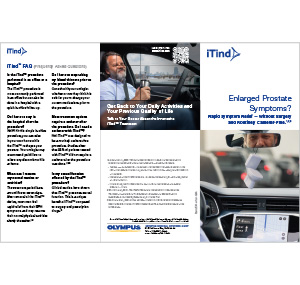

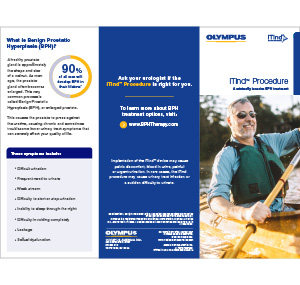

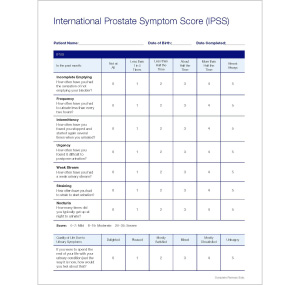

Find answers to commonly asked questions about the iTind procedure before seeing your doctor.
What is the iTind procedure?
The iTind procedure is a minimally invasive treatment for an enlarged prostate (BPH). A device is temporarily placed into the prostate for 5-7 days. During that time, it reshapes the prostate to help improve urine flow – and it’s completely removed afterward. No permanent implant is left behind.
How does it work?
Once inserted, the device expands and applies gentle pressure at key points in the prostatic urethra. Over the next few days, this creates channels in the prostate that reduce obstruction. After the device is removed, those channels remain for years – helping improve urinary symptoms like frequency, weak stream, and urgency.3
Will I feel the device while it’s in?
Some patients report mild pressure, burning during urination, or pelvic discomfort while the device is in place.
Is the procedure painful?
You may experience temporary discomfort while the device is in place, but it’s generally mild to moderate and improves quickly after removal.
Do I have to stay in the hospital?
No. The procedure is done in a doctor’s office or outpatient setting.1,2 Men go home the same day and return for a short follow-up visit 5–7 days later to have the device removed.
Stay in the know
- 1 Chughtai B, Elterman D, Shore N, et al. The iTind Temporarily Implanted Nitinol Device for the Treatment of Lower Urinary Tract Symptoms Secondary to Benign Prostatic Hyperplasia: A Multicenter, Randomized, Controlled Trial. Urology. 2021;153:270-276. doi:10.1016/j.urology.2020.12.022
- 2 De Nunzio C, Cantiello F, Fiori C, et al. Urinary and sexual function after treatment with temporary implantable nitinol device (iTind) in men with LUTS: 6-month interim results of the MT-06-study. World J Urol. 2021;39(6):2037-2042. doi:10.1007/s00345-020-03418-2
- 3 Amparore D, De Cillis S, Schulman C, Kadner G, Fiori C, Porpiglia F. Temporary implantable nitinol device for benign prostatic hyperplasia-related lower urinary tract symptoms: over 48-month results. Minerva Urol Nephrol. 2023;75(6):743-751. doi:10.23736/S2724-6051.23.05322-3
- 4 Urology Care Foundation. Benign Prostatic Hyperplasia (BPH) Patient Guide. 2023